

Most bloggers get the majority of their traffic from social media and site referrals. But having a blog which performs well on search engines can provide an incredible boost. Not only can it bring traffic to your site continuously, it usually brings relevant visitors, too. Here are a few tips to make your blog an SEO success.
Pick useful topics
Choosing what to write about is key, both in blogging generally and for SEO specifically. Search engines like Google thrive on giving users helpful answers, so a good way to obtain rankings is to answer queries.
Hence, things like ‘how to-s’, guides and reviews can be a very good way to get organic visibility. Doing your own checks can be useful as well. If you want to write about something, look it up and see what sites are appearing. If you see top results dominated by relatively unknown domains, this may just be your opportunity.
Get technical
There are many best SEO practice resources online, and if you’re not familiar with them you should definitely have a read.
Getting little things right on your site can make a big difference in SEO. Ensure your meta data is optimised to Google guidelines, get rid of broken URLs and page duplications, etc. It’s simple, and can take your blog a long way.
Create a link network
Having a vast network of links from other domains is one of the most important aspects of SEO. In the eyes of search engines, links are an indication that your site is an authority in its own field. And Google tends to rank authoritative sites high.
There are plenty of ways to gain links. Registering on relevant online lists and directories is a good start, and guest blogging can be a good approach as well. You should make sure you get links from relevant sites. Ultimately, the best way to generate links is to create great content people will naturally want to share and link to.
Get the length right
What constitutes good SEO content length is very much an open debate. However, correlation studies show that longer posts generally perform better in search engines. The graph below, for instance, shows that in a particular sample used, all page 1 results exceed 2000 words.
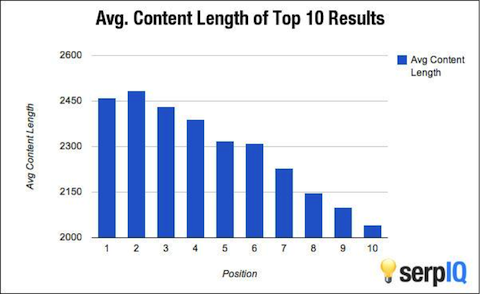
http://www.quicksprout.com/2014/03/31/how-long-should-each-blog-post-be-a-data-driven-answer/
And it makes sense. The more content there is on a page, the more information Google’s algorithm is given to digest and consider as reasons to rank. In some ways it’s a bit like the lottery: you’re not guaranteed to win, but the more you play the more likely you are to eventually win.
